
Understanding Pantone, HEX and CMYK Colours for Ribbon Printing
Understanding Pantone, HEX and CMYK Colours for Ribbon Printing
If you’re ordering custom printed ribbon, you’ve probably come across terms like Pantone, HEX, and CMYK. If you’re not a graphic designer, these colour systems can seem confusing.
The good news is that they’re simply different ways of identifying colours for different purposes.
This guide explains each colour system in plain English, what it’s used for, and which one works best when printing on polyester satin, trilobal satin, Petersham, and cotton ribbons.
Why Colour Matters
When you order printed ribbon, you want your logo and branding colours to look as close as possible to your company’s official colours.
Different printing methods reproduce colour in different ways, which is why designers use standard colour systems to communicate exactly which colour they want.
Think of colour systems like different languages. They all describe colour—but they’re used in different situations.
What is a Pantone Colour?
Pantone is an internationally recognised colour matching system used by professional printers and manufacturers.
Instead of describing a colour as simply “blue” or “red,” every Pantone colour has its own unique number.
For example:
-
Pantone 186 C – Bright Red
-
Pantone 2935 C – Royal Blue
-
Pantone 347 C – Green
This allows printers all over the world to reproduce the same colour consistently.
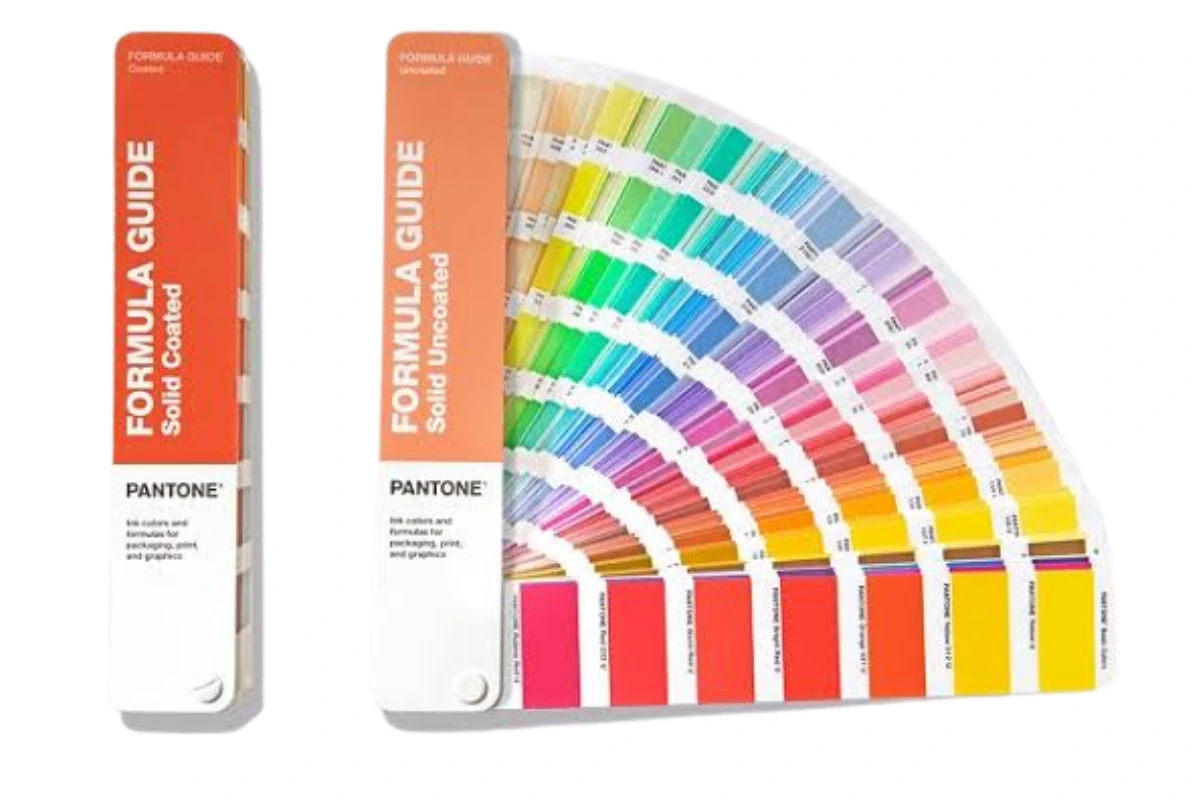
How Pantone Colours Work
Pantone colours are created by mixing specially formulated inks according to precise recipes.
Because every printer follows the same formula, Pantone colours produce highly consistent results.
This is why large brands such as Coca-Cola, Visa, BMW, and McDonald’s specify Pantone colours for their branding.
When Pantone Colours Are Used
Pantone colours are commonly used for:
-
Company logos
-
Brand identity
-
Packaging
-
Corporate stationery
-
Promotional products
-
Printed ribbon
If colour accuracy is important, Pantone is usually the preferred choice.
What is a HEX Colour?
HEX colours are used almost exclusively for digital screens.
A HEX colour is a six-digit code beginning with a # symbol.
For example:
-
#FF0000 = Red
-
#0057B8 = Blue
-
#000000 = Black
-
#FFFFFF = White
Computers, websites, mobile phones and apps use HEX codes to display colours.

Where HEX Colours Are Used
HEX colours are used for:
-
Websites
-
Mobile apps
-
Social media graphics
-
Email newsletters
-
Digital advertising
They are not printing colours.
If you send us a HEX code, we can usually match it as closely as possible using our printing process, but the printed ribbon may not look exactly the same as it appears on your screen.
This is because screens produce colour using light, while printing uses ink or foil.
[row_inner_3] [col_inner_3 span=”6″ span__sm=”12″]
What is CMYK?
CMYK is the standard colour system used for full-colour printing.
CMYK stands for:
-
C – Cyan
-
M – Magenta
-
Y – Yellow
-
K – Black
By combining different percentages of these four inks, thousands of colours can be produced.
[/col_inner_3] [col_inner_3 span=”6″ span__sm=”12″ align=”center”]

For example:
-
100% Cyan + 100% Yellow creates green.
-
Equal amounts of Cyan, Magenta and Yellow produce darker colours.
-
Black ink is added for depth and sharpness.
Most commercial printing presses use CMYK for brochures, magazines, catalogues and many printed products.
[row_inner_3] [col_inner_3 span__sm=”12″]
Which Colour System Do We Use for Ribbon Printing?
The answer depends on the printing method and the ribbon you’re ordering.
For custom ribbon printing on:
- Polyester satin ribbon
- Trilobal satin ribbon
- Lanyard Tape
- Petersham ribbon
- Cotton ribbon
- TPU Tape
we can work with artwork supplied in Pantone, CMYK or HEX formats.
If your business has official brand colours, Pantone colours usually provide the best reference for colour matching.
If your artwork only contains HEX or CMYK colours, we can generally convert them to the closest achievable printed colour.
Why Printed Colours May Look Different from Your Screen
One of the most common questions we receive is:
“Why doesn’t my printed ribbon look exactly like my computer screen?”
The answer is simple.
A computer or phone screen creates colour using light (RGB), making colours appear brighter and more vibrant.
Printed ribbon uses ink or metallic foil applied to fabric, which reflects light rather than producing it.
The ribbon material itself also influences the final appearance.
For example:
-
White satin produces bright, vibrant colours.
-
Coloured ribbons can alter the appearance of printed inks.
-
Cotton ribbons create a softer, more natural finish.
-
Metallic foil produces a reflective shine that cannot be replicated with ink.
Because of these factors, slight colour variations are normal.
Pantone vs HEX vs CMYK
| Colour System | Used For | Best Choice |
|---|---|---|
| Pantone (PMS) | Professional printing and branding | Best for accurate brand colour matching |
| HEX | Websites, apps and digital graphics | Best for digital design only |
| CMYK | Commercial full-colour printing | Best for printed artwork and photographs |
Which Colour Format Should You Send Us?
If possible, we recommend sending your artwork with:
-
Pantone colour references (best option)
-
Vector artwork (AI, EPS or PDF)
-
High-resolution logos
-
Any brand guidelines you may have
If you only have a logo from your website or a HEX colour, don’t worry—we can usually convert it and recommend the closest printing match.
[/col_inner_3] [/row_inner_3]